

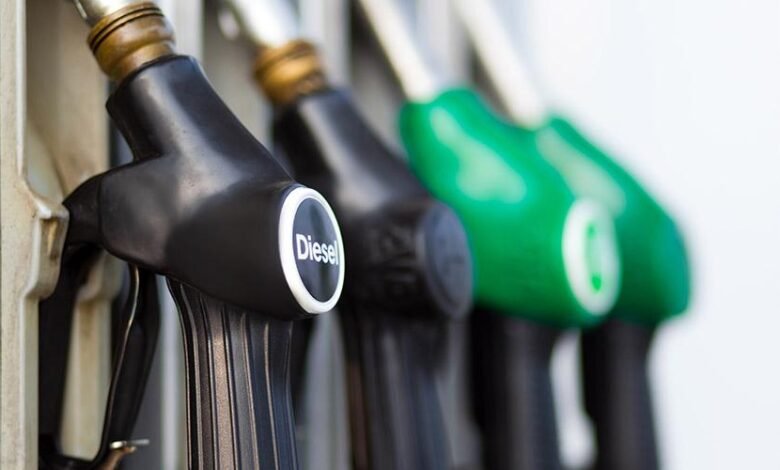
Diesel is running at roughly 282 cents a litre across the country this week — nearly 40 cents more than regular unleaded. If you drive a diesel ute, 4WD or van, that gap stings every time you fill up. Here is what diesel actually costs right now, how the price is set, and how to pay less for it.
Quick answer: today’s diesel price
As of 17 October 2026, the national average diesel price is about 282 to 284 cents a litre — roughly $169 for a 60-litre fill. Prices eased slightly over the past week, according to the ACCC’s weekly fuel monitoring update of 16 October 2026. Official weekly figures are published by the Australian Institute of Petroleum.
Diesel prices by state and territory
The table below uses the Australian Institute of Petroleum’s weekly diesel report for the week ended 4 October 2026 — the most recent dated official report available at the time of writing.
| State / territory | Average (c/L) | Metro average (c/L) |
|---|---|---|
| NSW / ACT | 284.2 | Sydney 281.1 · Canberra 293.1 |
| Victoria | 284.3 | Melbourne 284.1 |
| Queensland | 287.1 | Brisbane 286.8 |
| South Australia | 288.0 | Adelaide 287.8 |
| Western Australia | 277.9 | Perth 275.3 |
| Northern Territory | 301.9 | Darwin 291.9 |
| Tasmania | 288.5 | Hobart 287.7 |
| National | 284.7 | 283.0 |
Two things stand out: Western Australia is consistently the cheapest state (Perth metro averaged 275.3c), while the Northern Territory is the dearest — regional NT averaged 317.4c a litre. Regional areas overall averaged 286.1c, about 3 cents above the metro average of 283.0c. So if you are driving out of the city, fill up before you leave.
How diesel prices are set
There is no single person or company deciding the diesel price. The Australian Institute of Petroleum explains it like this, and it is worth knowing because it shapes everything else:
- The starting point is overseas. Australia is a price taker. The benchmark that matters for diesel is the Singapore Gasoil price (the price of refined diesel in Asia). When that moves, our pump prices follow.
- Shipping and taxes do most of the rest. The Gasoil price plus shipping costs plus Australian taxes make up roughly 95% of the wholesale price of diesel.
- Taxes are a fixed chunk. Fuel excise and GST are built into every litre, and they do not move with the oil market. (The federal government temporarily cut fuel excise for three months from April 2026, which took some pressure off prices then.)
- The terminal gate price is the wholesale benchmark. From the terminal, stations add land transport to get fuel to the bowser, plus the costs of running the site — wages, rent, utilities, marketing — and a retail margin.
Why diesel doesn’t have a cheap day
Petrol prices in the big cities swing up and down in a discount cycle — cheap days and dear days. Diesel does not work that way, and waiting for the price to drop is usually pointless. According to the AIP, only about a quarter of diesel is sold through retail outlets, and most of that goes to contract or fuel-card customers. The bulk of diesel is sold to commercial and industrial users — mining, transport, farming — on long-term contracts. There is no sawtooth cycle for diesel; the price just drifts with the wholesale market.
Why diesel costs more than petrol right now
Diesel is currently about 38 to 40 cents a litre dearer than regular unleaded. That is not unusual — diesel has traded above petrol for years — but the gap has been wide since the conflict in the Middle East began in late February 2026, which pushed crude and refined fuel prices sharply higher. Brent crude was trading near US$110 a barrel in mid-October 2026 on continued supply concerns.
To put the swings in perspective: the AIP’s national average diesel price was 180.9 cents in the week ended 1 March 2026, spiked to 308.9 cents by mid-April, then settled back to around 248 cents by August. It has climbed again through September and October. Motoring groups note that retail margins on diesel are typically slim — the high prices are driven by international wholesale costs, not by stations taking a bigger cut.
How to find the cheapest diesel near you
Because diesel has no price cycle, where you fill up matters more than when. These free tools all pull from official reporting schemes or live station data:
- FuelCheck (NSW) — the NSW government’s real-time fuel price reporting scheme. Check prices before you drive to the bowser.
- FuelWatch (WA) — WA retailers must lodge tomorrow’s prices by 2:30pm AWST, and they are then locked for 24 hours. You can see in advance which stations are going up or down.
- MotorMouth — a national fuel price comparison site with suburb-level prices.
- FuelRadar — live national and state averages plus station-level reports.
- RACQ app (Queensland) — shows live pump prices across the state, which runs its own real-time reporting scheme.
South Australia also runs a real-time reporting scheme, and Victoria has a daily price-cap scheme — so most drivers now have access to same-day prices for their area.
7 ways to pay less for diesel
- Compare stations, not days. With no diesel price cycle, the saving is in station choice. Price trackers show spreads of 30 to 50 cents a litre between the cheapest and dearest stations in the same city — that is $15 to $25 on a 50-litre fill.
- Try independents. Smaller independent brands consistently undercut the majors on diesel, often by several cents a litre.
- Fill up in the city before long trips. Regional diesel averages about 3 cents more than metro, and in remote areas the gap is far bigger.
- Use shopper docket discounts. Supermarket dockets and loyalty offers typically knock 4 cents or more off the bowser price — check the fine print for diesel caps.
- Keep tyres pumped up. Under-inflated tyres make a diesel ute or van work harder. Check pressures monthly against the placard on the driver’s door.
- Ditch the dead weight. Roof racks, toolboxes and gear you don’t need all burn extra diesel. A lighter load means fewer litres.
- Ask about fuel cards. If you drive for work, a fleet or small-business fuel card can beat the bowser price — most diesel is sold this way for a reason.
Diesel fuel prices: FAQs
What is the average diesel price right now?
About 282 to 284 cents a litre nationally, as of 17 October 2026 — roughly $169 for a 60-litre tank. Western Australia is cheapest (around 278c), the Northern Territory dearest (around 302c).
Why is diesel more expensive than petrol?
Diesel tracks a different international benchmark, the Singapore Gasoil price, and is in heavy industrial demand worldwide. Unlike petrol, it has no retail discount cycle, so there is no cheap day to wait for.
Will diesel prices go down soon?
No one can promise that. Diesel follows the international Gasoil price and crude oil, which have been volatile since the Middle East conflict began in early 2026. The ACCC reported a slight decrease in the week to 16 October 2026, but prices remain near historic highs.
Is premium diesel worth the extra cost?
For most vehicles, standard diesel is fine — check your owner’s manual. Premium diesel is marketed as having better additives, but the price premium rarely pays for itself in a normal commuter or work ute.
How often do diesel prices change?
Diesel moves steadily with the wholesale market rather than in weekly cycles, so prices at a given station can change any day. Check a live price app before you fill up.