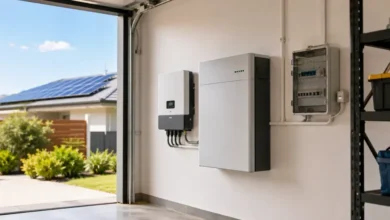


No. Solar panels stop making electricity once the sun goes down, because they need sunlight to work. But that doesn’t mean your home goes dark. After sunset, your house simply runs on power from a home battery if you have one, or from the grid like any other home.
If you already have solar panels, or you’re thinking about getting them, the real question is what happens to your power at night — and whether a battery is worth it. Here is the full picture.
Why Solar Panels Stop Working at Night
Solar panels work through the photovoltaic effect. Sunlight hits the cells in the panel and knocks electrons loose, creating direct current (DC) electricity. Your inverter then turns that into the alternating current (AC) your home uses.
No sunlight means no electrons moving and no power. It is that simple, and it is not a fault with your panels or your installer. Even the best panels on the market can’t generate electricity in the dark.
Moonlight doesn’t help either. Moonlight is just reflected sunlight, and it is far too weak to generate any usable power. Your inverter won’t even switch on for it.
What Happens When the Sun Goes Down?
Nothing dramatic. As the light fades in the late afternoon, your panels produce less and less. At dusk the inverter switches off, and your home automatically starts drawing electricity from the grid — or from your battery if you have one. There is no flicker, nothing you need to switch over, and no gap in supply.
In the morning the process reverses. As soon as there is enough light, the inverter wakes up and your panels start generating again.
Do Solar Panels Work on Cloudy Days or in the Rain?
Yes, just not as well. Panels run on light, not heat, so they still generate power under cloud cover, though output can drop to around 10 to 25 per cent of maximum on a heavily overcast day. Light rain doesn’t stop them either, and it has the bonus of washing dust off the panels.
Overcast mornings and late afternoons still produce something. It is only full darkness that brings output to zero.
How to Use Solar Power at Night
There are two ways to keep using solar energy after dark, and plenty of solar homes use both.
1. A home battery
A battery stores the extra electricity your panels make during the day and releases it at night. If your panels make more than your home uses while the sun is up, the surplus charges the battery instead of going to the grid. After sunset, the battery powers your home.
Batteries have become much cheaper to buy thanks to the federal Cheaper Home Batteries Program, which started on 1 July 2025. It gives a discount of around 30 per cent off the upfront cost of an eligible battery, handled by your installer through small-scale technology certificates. To qualify, the battery must be between 5 and 100 kWh, connected to a solar system, on the Clean Energy Council’s approved product list, and installed by an accredited installer. The discount applies to the first 50 kWh of capacity, and it steps down over time until the program ends in 2030. For a typical 10 kWh battery, the saving works out to roughly $3,700 to $4,000.
A battery makes the most sense if your household uses a lot of power in the evening — cooking, heating or cooling, washing, and charging devices — because that is the power you would otherwise buy from the grid at full retail price.
2. The grid, and your feed-in tariff
Without a battery, any extra power your panels make during the day is exported to the grid, and your retailer pays you a feed-in tariff for it — typically around 3 to 10 cents per kWh. At night you buy power back from the grid at the normal retail rate, which is far higher than the feed-in rate.
That gap is why it pays to use as much of your own solar power as you can while the sun is up. Running the washing machine, dishwasher, or pool pump in the middle of the day uses power that cost you almost nothing to make. Exporting it and buying it back later is the expensive way around.
It also helps to know when off-peak electricity applies, because power bought from the grid late at night is usually the cheapest of the day. Shifting flexible jobs — like running the dishwasher or charging an electric car — into off-peak hours can cut the bill further. You can compare plans and tariffs for your area on the government’s free comparison site, Energy Made Easy.
Is a Battery Worth It?
It depends on how you use power. A battery is usually worth a closer look if:
- Most of your electricity use happens in the evening, after your panels stop generating.
- You export a lot of solar power during the day and buy a lot back at night.
- You are on a time-of-use tariff, where evening power costs far more than daytime power.
- You want some backup during blackouts (see below).
A battery is less useful if your home uses most of its power during the day, or if your system is small and rarely exports anything. Get quotes from two or three accredited installers, and ask each one to work out the payback time based on your actual bills — not on a generic estimate. If your plan also charges for peak demand, a battery can help there too by keeping your evening peak down — see our simple guide to what a demand tariff is.
What Happens in a Blackout?
A standard grid-connected solar system shuts down during a blackout, even in full sun. This is a safety rule: it stops your system feeding electricity into lines that workers may be repairing. Some batteries with backup capability can keep essential circuits running during an outage, but that has to be set up when the battery is installed — it is not automatic on every system.
Do Solar Panels Work at Night? FAQs
Do solar panels work at night?
No. Solar panels need sunlight, so they stop generating after sunset. Your home keeps running on battery power or grid power instead.
Can solar panels charge a battery at night?
No. A battery can only be charged while the panels are generating, which is during daylight hours. At night the battery discharges to power your home.
Do solar panels work on cloudy days?
Yes, at reduced output. Panels use light, not heat, so they still generate on overcast days — roughly 10 to 25 per cent of maximum output under heavy cloud.
Do solar panels work in the rain?
Yes. Rain doesn’t stop panels from generating, and it helps by washing dust off them. Output is lower than on a clear day, but it is not zero.
Do solar panels work during a blackout?
No, not unless you have a battery with backup capability. A standard grid-connected system switches off during a blackout for safety, even in daylight.
Can I use solar power at night without a battery?
Not directly. Without a battery, your night-time power comes from the grid. What you can do is earn feed-in tariff credits for the power you export during the day, which offsets some of what you buy back at night — but the credit per kWh is much smaller than the price you pay.