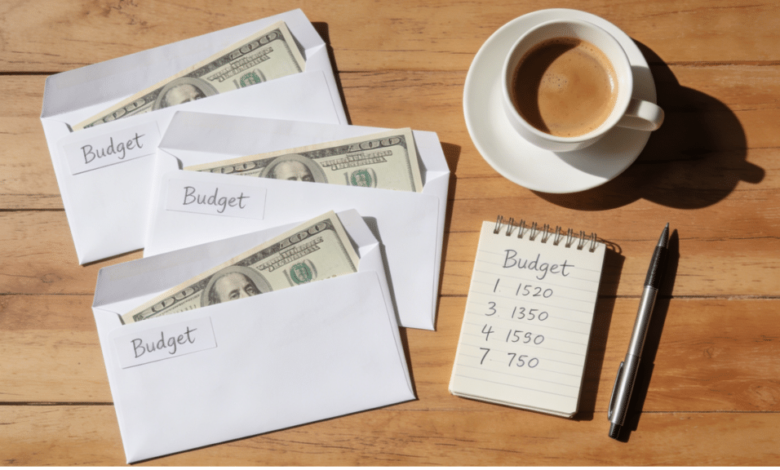
A cash budget is one of the simplest ways to stop overspending. Instead of tracking every card payment in an app, you decide in advance how much cash you will spend in each part of your life, put that money aside, and when an envelope is empty, spending in that category stops. It sounds old-fashioned, but that is exactly why it works: you can see the money leaving your hands.
Quick answer: To do a cash budget, write down your take-home pay, list your spending categories, give each one a fixed cash amount for the month, withdraw that cash and divide it into labelled envelopes, spend only from the matching envelope, and check what is left each week. For a free official tool to work out your numbers first, try the MoneySmart budget planner.
What is a cash budget?
A cash budget is a spending plan built around physical cash. You work out how much money you have coming in, decide how much goes to each area of your spending, and then handle that money as cash rather than as numbers on a screen. The best-known version is the cash envelope method: each category gets its own envelope, and you only spend what is inside it.
There is also a business version of the term. For a small business, a cash budget is a short forecast of the cash expected to come in and go out over the next few weeks or months, so the owner can see in advance whether there will be enough money to pay the bills. This guide focuses on the personal cash budget, with a short section on the business version near the end.
How to do a cash budget step by step
Step 1: Work out your take-home pay
Start with the money that actually lands in your account after tax, not your gross salary. Add up your regular pay, plus any other income you can rely on, such as a side job or regular government payments. If your pay changes from week to week, add up the last three months and divide by three to get a monthly average. Budget on a slightly low figure rather than your best month ever.
Step 2: List your spending categories
Go through your last two or three months of bank statements and sort your spending into groups. Most people need no more than six or seven envelopes. Common ones are groceries, transport and petrol, eating out, entertainment, clothing, personal care, and household items.
Some costs do not belong in envelopes at all. Rent or mortgage payments, insurance, phone and internet bills, loan repayments and subscriptions are usually paid by direct debit, so leave them out of the cash system and pay them from your account as normal.
Step 3: Give each category a cash limit
Decide how much cash each envelope gets for the month, based on what you actually spent before, not what you wish you spent. If you spent $600 a month on groceries, setting the envelope at $400 will only lead to a raid on another envelope in week two. Cut the amounts gradually instead.
A simple worked example for a monthly take-home pay of $4,000:
| Category | Cash amount |
|---|---|
| Groceries | $600 |
| Transport and petrol | $250 |
| Eating out | $200 |
| Entertainment | $150 |
| Clothing and personal care | $150 |
| Household items | $100 |
| Total cash | $1,450 |
The remaining $2,550 covers the fixed bills paid from the bank account, savings, and anything you set aside for irregular costs such as car registration or gifts.
Step 4: Withdraw the cash and fill the envelopes
On payday, withdraw the total cash amount and divide it between labelled envelopes, one per category. Some people use paper envelopes, others use a wallet with dividers or a cash wallet with labelled pouches. It does not matter what you use, as long as each category is kept separate.
Step 5: Spend only from the matching envelope
This is the rule that makes the whole system work. Groceries come out of the groceries envelope. If the eating-out envelope is empty on the 25th of the month, you cook at home until payday. Moving money between envelopes is allowed in a real emergency, but if you do it every week, the limits are wrong and need adjusting, not ignoring.
Step 6: Check what is left each week
Take five minutes at the end of each week to look inside the envelopes. Money left over is a win: move it to savings or into next month’s envelopes. An envelope that runs dry in the first week tells you the limit was too tight, or that the spending needs a closer look. Adjust the amounts next month and keep going. Most people need two or three months before the amounts feel right.
Cash budget vs a normal budget
A normal budget is a plan on paper or in an app. A cash budget is the same plan made physical. The difference is the friction: tapping a card feels like nothing, while handing over notes makes the cost real. That is why the cash method suits people who keep overspending in the same categories, such as takeaway food, clothes or entertainment, even though they know their budget.
It is not perfect for everything. Direct debits, online shopping and bills cannot run on envelopes, and carrying large amounts of cash is not practical or safe for everyone. Many people use a hybrid: envelopes for the flexible spending they struggle to control, and card payments for everything else.
Common mistakes to avoid
- Setting limits too low. A budget you cannot live on for a month will be abandoned by week two. Base the amounts on real spending, then trim a little at a time.
- Too many envelopes. More than seven or eight categories becomes hard to manage. Keep it simple and combine small categories.
- Forgetting irregular costs. Car registration, gifts, school costs and medical bills are not monthly, but they are not surprises either. Set aside a little cash for them each month.
- Skipping the weekly check. Without a quick review, an empty envelope is only discovered at the checkout. Five minutes a week keeps the system honest.
Cash budget for a small business
For a small business, a cash budget is a short forecast rather than a set of envelopes. List the cash you expect to receive each week or month, such as customer payments, and the cash you expect to pay out, such as supplier bills, wages, rent, tax and loan repayments. Start with your opening bank balance and work out the expected closing balance for each period.
The point is timing. A business can be profitable on paper and still run out of cash, because a customer pays in March for work finished in January. A simple cash budget shows the lowest expected balance before it happens, so you can chase late payments, delay a purchase or arrange short-term finance in time.
Frequently asked questions
How much cash should I budget each month?
There is no fixed figure. Add up what you actually spent on flexible categories over the last three months, divide by three, and use that as your starting point. Then trim the categories you most want to cut by a small amount each month.
Does a cash budget really save money?
It can, because it makes spending visible and sets a hard stop when the money runs out. People who struggle with card overspending often find they spend less on the categories they put in envelopes. The saving comes from the limit, not from the cash itself.
Can I do a cash budget without physical envelopes?
Yes. Some banks let you split your account into separate sub-accounts or “buckets” for each category, and some budgeting apps offer virtual envelopes. The idea is the same: a fixed amount per category and a clear signal when it is gone.
What if I run out of cash before payday?
First, check whether the limit was realistic. If the amount was fair and you still ran out, look at what the money went on and whether a few purchases could wait until next month. Do not top up the envelope from savings as a habit, or the system loses its point.
This article gives general information only. It is not personal financial advice. If you need advice about your own situation, speak to a licensed financial adviser.