

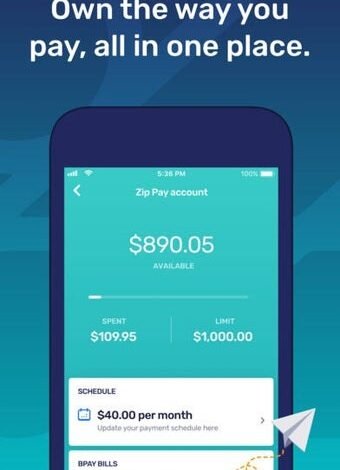
Zip Pay is the buy now, pay later account from Zip Co (zip.co) that lets you shop now and pay later in weekly, fortnightly or monthly repayments — with no interest. It comes with a credit limit of up to $1,000 and a $9.95 monthly account fee that is waived when you pay your closing balance in full by the statement date.
Quick Answer: What Is Zip Pay?
Zip Pay is Zip’s interest-free BNPL account built for everyday spending. You apply online (approval usually takes minutes), get a digital Visa card you can use online or in-store anywhere Visa is accepted, and repay your balance over time — from as little as $10 a week. Unlike a credit card, there is no interest on Zip Pay. The catch: a $9.95 monthly account fee applies whenever you carry an outstanding balance, so it works best if you clear your balance each month.
How Zip Pay Works
Once approved, Zip Pay gives you a line of credit up to $1,000 that you can draw on again as you repay. You can:
- Tap & Pay in-store — add Zip Pay to your digital wallet and use it wherever contactless payments are accepted.
- Shop online — use the single-use card feature or your digital Visa card at checkout.
- Pay bills via BPAY — settle household bills through the Zip app.
- Buy gift cards — purchase gift cards for brands that don’t accept Zip directly.
Repayments are automatically direct debited from the payment method you nominated when you signed up. You can change the payment method and the frequency (weekly, fortnightly or monthly) at any time, as long as you meet the minimum monthly repayment.
Zip Pay Fees Explained
Zip Pay is interest-free, but it is not free. Here is what it can cost:
- Monthly account fee: $9.95 — charged whenever you have an outstanding balance at the end of the statement period. It is waived entirely if you pay your closing balance in full by the due date.
- No establishment or annual fees.
- Late payment fee — can apply if you stop making repayments (around $7.50 if no repayments are made for more than 21 days).
The rule of thumb: if you clear your balance every month, Zip Pay costs you nothing. If you only make the minimum repayments, you will pay $9.95 every month you owe anything — that adds up to $119.40 a year, which can make a small purchase surprisingly expensive.
Who Can Get Zip Pay?
To be eligible you must:
- Be at least 18 years old
- Be an Australian citizen or permanent resident
- Have a valid and verifiable mobile number and email address
- Have a verified PayPal or online bank account in your own name
- Have a valid driver’s licence or passport and a good credit history
Because Zip Pay is a line of credit, Zip may run a credit check as part of your application under its responsible lending obligations.
Zip Pay vs Zip Plus vs Zip Money
Zip has three products and they are easy to mix up. Here is how they compare:
| Zip Pay | Zip Plus | Zip Money | |
|---|---|---|---|
| Credit limit | Up to $1,000 | $2,000–$20,000 | $1,000–$5,000 (up to $50,000 through select merchants) |
| Interest | Interest-free | Interest-free if balance is $1,000 or less at month end; otherwise 13.70% p.a. | Up to 3 months interest-free per purchase, then 25.9% p.a. |
| Monthly fee | $9.95, waived if balance paid by due date | $9.95, waived if nothing owing | $9.95, waived if nothing owing |
| Min repayments | From $10/week | From $25/month | From $50/month |
Zip Pay suits small everyday purchases. Zip Plus is aimed at bigger everyday spending with higher limits, and Zip Money is the line of credit for larger one-off purchases.
What’s Happening With Zip Right Now?
Zip made headlines on 23 October 2026 when it released its first-quarter FY27 trading update. The company disclosed an external fraud event in the US, where coordinated individuals opened new accounts using legitimate credentials to make unpaid transactions. The incident cost Zip US$7.2 million (about A$10.1 million) in extra operating expenses and temporarily slowed transaction and customer growth in July and August, though US volumes strengthened again in September.
Investors reacted sharply: Zip’s share price fell as much as 50.5% in early trade to A$1.025 — wiping about A$1.3 billion off its market value — before recovering some ground to end the session down roughly 29%. Underneath the drama, the numbers were still strong: total transaction volume rose 18% to $4.6 billion, active customers held steady at 6.4 million, and the company reconfirmed its full-year guidance, including group cash earnings (EBTDA) of $340 million. It also said it had notified the relevant authorities and lodged a claim with its insurer.
Is Zip Pay Safe and Legit?
Yes. Zip is a legitimate Australian company listed on the ASX (ticker: ZIP) and its credit products are provided by ZipMoney Payments Pty Ltd (Australian Credit Licence 441878). The usual consumer caution applies to any BNPL product: missing payments can damage your credit score and trigger fees, so only borrow what you can comfortably repay.
FAQs
Does Zip Pay affect my credit score?
Zip may perform a credit check when you apply, and missed repayments on a credit product can be recorded and affect your score — treat it like any other credit.
Can I use Zip Pay anywhere?
Your digital Visa card works online and in-store anywhere Visa is accepted, plus BPAY and gift cards cover gaps where Visa isn’t taken.
How do I avoid the $9.95 monthly fee?
Pay your statement closing balance in full by the due date. When you do, the fee is waived and Zip Pay is genuinely free.
What’s the difference between Zip Pay and Zip Money?
Zip Pay is the interest-free account with limits up to $1,000. Zip Money is a line of credit for larger purchases ($1,000–$5,000), with up to 3 months interest-free per purchase and 25.9% p.a. on balances after that.
This article is general information only, not financial advice. Fees and terms can change — always check Zip’s current terms before signing up.