
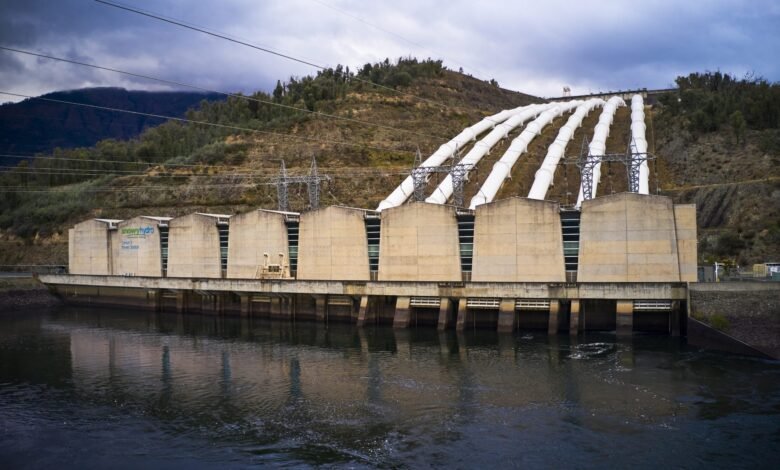
Alinta Energy has pulled the plug on the Oven Mountain pumped hydro project, a $1.8 billion plan to build one of the biggest “water batteries” in New South Wales. After years of studies and planning, the company announced on 22 October 2026 that it was walking away, blaming rising costs and hold-ups to a critical transmission line.
If you have never heard of Oven Mountain, you are not alone. Here is what the project was, why it fell over, and what it means for households.
The short version
- What happened: Alinta Energy and its partner OMPS have discontinued the Oven Mountain Pumped Hydro project in northern NSW.
- Why: “Economic and timing challenges on key elements of the project, including a critical transmission line” made it unviable, the company said in its official statement.
- The scale: 900 megawatts with eight hours of storage — enough, Alinta said, to power more than 600,000 homes.
- The price tag: about $1.8 billion.
- When: announced 22 October 2026. The project never got built; it was still going through planning and assessment.
What the Oven Mountain project was
Oven Mountain was a proposed pumped hydro energy storage scheme near the rural hamlet of Carrai, between Armidale and Kempsey in northern New South Wales. The site sits on the Macleay River, inside the New England Renewable Energy Zone.
The plan was simple in concept: build two reservoirs at different heights and pump water more than 600 metres uphill when electricity is cheap and plentiful, usually in the middle of the day when solar output is high. Then, when demand spikes in the evening, let the water run back downhill through turbines to generate power.
At 900 megawatts for eight hours, it would have stored up to 7,200 megawatt-hours of energy. That is more than twice the energy storage of Origin Energy’s big battery at Eraring, which will reach 700 megawatts and 3,160 megawatt-hours once all stages are complete.
The project was declared critical state significant infrastructure back in 2020. Since then Alinta had spent years on technical studies, environmental assessment, and talking to landholders and the local community. But not a single turbine had been built.
Why Alinta walked away
Alinta’s statement was short: “economic and timing challenges on key elements of the project, including a critical transmission line, made it unviable to proceed.”
Translated into plain English: big energy projects live or die on transmission. A pumped hydro plant is useless if there is no power line big enough to carry its electricity to where people actually use it. Building that line is its own mega-project, with its own approvals, landowners, and timetable.
When costs keep climbing and the transmission line keeps slipping, the maths stops working. Alinta said it looked at every available option before deciding the project was “no longer viable to progress.”
This is not just an Alinta problem. Across the industry, large storage and renewable projects are being squeezed by higher construction costs and slow transmission build-outs.
Who is Alinta Energy?
Alinta Energy is one of the country’s major energy retailers and generators, selling electricity and gas to homes and businesses. It is Singapore-owned: conglomerate Sembcorp Industries completed its takeover of Alinta in June 2026.
The Oven Mountain project was being developed with its partner OMPS. In its farewell statement, Alinta thanked “the community, Traditional Custodians, landholders, MPs and council representatives, suppliers, key agencies, and many other key stakeholders” for their input over the years.
A rough month for big renewable projects
Oven Mountain is the second state-significant renewable project to fall over in northern NSW this month. Earlier in October, Origin Energy walked away from its proposed 870-megawatt Skye Ridge Wind Farm near Walcha, not far from the Oven Mountain site.
Both projects ran into the same headwinds: rising costs and the sheer difficulty of getting big infrastructure approved and connected. For a state counting on new storage to replace retiring coal plants, losing two major projects in a matter of weeks is a setback.
What it means for your power bill
The honest answer: nothing right away. Oven Mountain was years from generating a single watt, so its cancellation changes nothing on your next bill.
The longer-term picture is less comfortable. Evening peaks are the expensive part of the day for the grid. Pumped hydro is one of the cheapest ways to cover those peaks once built, because it can run for eight hours straight, long after solar has gone to bed. Every big storage project that falls over leaves the grid a little tighter and a little more reliant on gas peaking plants, which tend to set high prices when demand surges.
None of that shows up tomorrow. But it is one more reason wholesale electricity costs stay stubborn.
How pumped hydro actually works
Think of it as a giant rechargeable battery made of water and gravity.
- Charge: when power is cheap, pumps push water from a lower reservoir up to a higher one. The energy is now stored as height.
- Discharge: when power is expensive, the water is released downhill through turbines, generating electricity on demand.
- Repeat: the same water goes around again. The reservoirs can keep cycling for decades.
The Snowy 2.0 scheme in the Snowy Mountains, still under construction, works on exactly this principle, just on a much bigger scale.
What happens next
Alinta says development work has stopped. The project’s website now carries the discontinuation notice, and the NSW planning assessment goes no further.
Whether the site is ever revived by someone else is anyone’s guess. For now, Oven Mountain joins the list of big energy ideas that never made it past the drawing board.
Quick questions
Where exactly was it?
Near Carrai, about 60 kilometres south-east of Armidale and 75 kilometres north-west of Kempsey, on the Macleay River in northern NSW.
Was any of it built?
No. It never left the planning and assessment phase.
Who pulled the plug?
Alinta Energy, together with its project partner OMPS.
Does this kill pumped hydro in NSW?
No. Snowy 2.0 is still being built. But the cancellation shows how tough the economics of big storage projects have become.