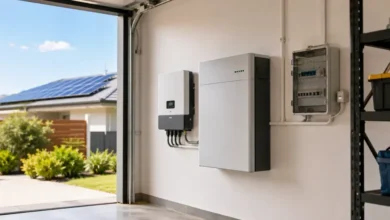


Your solar panels get all the attention, but your inverter does the real work. Every watt your panels make passes through it, so a poor inverter can hold back even the best panels. The good news is that the choice is simpler than it looks: a handful of brands dominate the market, and each one suits a different kind of home.
Quick answer: For most homes, the Sungrow SH series is the best all-round pick — strong hybrid capability, up to 98.4% efficiency and a fair price. If you want the most reliable inverter money can buy, choose the Fronius Gen24 Plus. For shaded or tricky roofs, Enphase IQ8 microinverters are the pick. All prices below are indicative installed prices for a 5kW unit, including GST, checked 11 November 2026. Before you buy, check the model is on the Clean Energy Council approved product list — only listed inverters qualify for the federal STC rebate.
What does a solar inverter actually do?
Solar panels produce direct current (DC) electricity. Your home runs on alternating current (AC). The inverter converts one into the other — and modern inverters do much more than that. They track the best operating point of your panels, manage power flow between your panels, battery and the grid, limit exports to meet your network’s rules, shut the system down safely in a fault, and show your system’s performance on a phone app.
There are three main types. String inverters are the most common — one central unit for all your panels, and the cheapest option for a straightforward roof. They suit about 70% of residential installs. Hybrid inverters combine a string inverter and a battery inverter in one box, so you can add a battery later without extra hardware. A hybrid costs roughly $500 more upfront but saves you $1,500 to $2,500 on a retrofit later. Microinverters sit behind each panel, so shade on one panel does not drag the rest down. They cost more upfront but carry 25-year warranties.
How we picked these 7 inverters
We judged each inverter on five things that matter over a system’s life: conversion efficiency, warranty length and local support, whether it is battery-ready, whether it is on the Clean Energy Council approved list, and real-world value — price against what you actually get. Every brand below is CEC-approved and widely installed. Prices are indicative installed prices for a 5kW single-phase unit, including GST, as published in November 2026. Your quote will vary with roof complexity, cable runs and location, so always get at least two or three quotes from CEC-accredited installers.
Best solar inverters compared
| Inverter | Type | Peak efficiency | Warranty | 5kW price (installed) | Best for |
|---|---|---|---|---|---|
| Sungrow SH series | String + hybrid | Up to 98.4% | 10 years | $1,000–$1,800 | Best overall value |
| Fronius Gen24 Plus | String + hybrid | Up to 98.1% | 10 years (extendable to 20) | $1,800–$2,500 | Premium reliability |
| GoodWe EH / DNS series | String + hybrid | Up to 97.6% | 10 years | $900–$1,600 | Mid-range, battery-ready |
| Enphase IQ8 | Microinverters | 97% CEC efficiency | 25 years | Higher upfront (per panel) | Shaded or complex roofs |
| SolarEdge Home Hub | Hybrid + optimisers | Up to 99% (with optimisers) | 12 years (extendable to 25) | Roughly $2,000–$2,500 hardware | Panel-level optimisation |
| SAJ R5 / H1 series | String + hybrid | Up to 97.3% | 10 years | $800–$1,300 | Best budget pick |
| Growatt MIN / SPH series | String + hybrid | Up to 97.0% | 10 years | $700–$1,200 | Cheapest simple setup |
1. Sungrow SH series
Best for: most homes — the best balance of price, performance and battery readiness.
Sungrow is the world’s second-largest inverter maker, with 225 gigawatts installed globally, and in a 2026 survey of 125 installers it ranked first overall, ahead of Fronius. The SH series hybrid inverters are the most-installed in the country for good reason: up to 98.4% peak efficiency, a standard 10-year warranty, and a hybrid design that pairs neatly with Sungrow’s own SBR battery if you add storage later. Monitoring runs through the iSolarCloud app, which is functional rather than fancy. If you want one safe default choice, this is it.
2. Fronius Gen24 Plus
Best for: homeowners who want the most reliable inverter available, whatever the cost.
Fronius is an Austrian company founded in 1945, and its inverters have been sold here for more than a decade. Installers consistently rate them the most reliable on the market, and the Gen24 Plus regularly runs for 15 years or more. It offers up to 98.1% efficiency, dual MPPT inputs for panels facing different directions, fan cooling that holds up in extreme heat, and the Solar.web monitoring platform — the most detailed app in this list. The 10-year warranty extends to 20 years. The trade-off is price: roughly $500 to $800 more than an equivalent Sungrow or GoodWe. Over a 15-year life, that premium often pays for itself in reliability alone.
3. GoodWe EH / DNS series
Best for: a battery-ready hybrid at a mid-range price, with freedom to choose your battery later.
GoodWe was established in 2010 and is listed on the Shanghai Stock Exchange. Its EH and DNS hybrid inverters reach up to 97.6% efficiency and work with GoodWe’s own Lynx Home batteries as well as third-party batteries — handy if you want battery capability now but have not picked a battery brand yet. The SEMS Portal app covers monitoring, and installation is straightforward for CEC-accredited installers. Brand recognition is lower than Fronius or Sungrow, but installer confidence in GoodWe has grown steadily since 2022.
4. Enphase IQ8 microinverters
Best for: shaded roofs, split orientations, or anyone who wants a 25-year warranty.
Enphase takes a different approach: instead of one big inverter, a small IQ8 microinverter sits behind every panel. Shade or dirt on one panel cannot drag the rest of the system down, and each panel is monitored individually through the Enphase app. The big selling point is the warranty — 25 years under Enphase’s Australia and New Zealand limited warranty, matching the panels themselves, so there is no mid-life inverter replacement to budget for. Efficiency is 97% CEC. The catch is cost: microinverters are priced per panel, so a whole system costs more upfront than a single string inverter. They pair with the Enphase IQ Battery 5P if you add storage. Choose these when your roof is shaded or faces several directions.
5. SolarEdge Home Hub
Best for: panel-level optimisation on tricky roofs, with battery storage built in.
SolarEdge combines a hybrid inverter with a small optimiser on every panel, so each panel performs at its own best level regardless of what its neighbours are doing. That makes it a strong pick for roofs with partial shade or panels facing different ways. The Home Hub inverter carries a 12-year standard warranty, extendable to 25 years, and works with SolarEdge home batteries. Expect roughly $2,000 to $2,500 for the inverter hardware on a typical home system, before installation. It is a premium-priced system, but for a shaded roof the extra energy it recovers can be worth it.
6. SAJ R5 / H1 series
Best for: smaller homes and tighter budgets that still want a CEC-approved inverter.
SAJ is one of China’s largest power electronics makers, with more than 20 years of experience. Its R5 and H1 series cover single-phase systems from 1.5kW to 6kW, which suits smaller homes and moderate energy needs, and hybrid models are available for future battery storage. Peak efficiency reaches 97.3% and the standard warranty is 10 years. Monitoring runs through the basic but functional eSolar Air app. The trade-off is a smaller installer network here, so service response can be slower than the big brands. For a straightforward system on a budget, it is a solid choice.
7. Growatt MIN / SPH series
Best for: the lowest upfront cost on a simple, unshaded roof.
Growatt is one of the most-installed inverter brands in the world, with more than 7 million units shipped. Its MIN series covers single-phase homes and the SPH series adds hybrid battery capability. Peak efficiency reaches 97% with a 10-year warranty, and at $700 to $1,200 installed for a 5kW unit it is the cheapest option in this list. Monitoring runs through the Shine app. The trade-off is thinner after-sales support and a shorter track record here than the European brands, and it is not the pick for complex commercial systems. If your goal is the fastest payback on a simple north-facing roof, Growatt delivers it.
How to choose the right inverter for your home
Work through four questions in order. First, will you add a battery? If there is any chance within the next five to ten years, choose a hybrid inverter now — Sungrow, GoodWe or Fronius. The federal Cheaper Home Batteries Program, which started 1 July 2025, cuts roughly 30% off the cost of an eligible home battery, so a battery-ready inverter is a smart bet. Our guide to the home battery rebate explains what is on offer. Second, what is your budget? Under $1,200 points to Growatt or SAJ; $1,200 to $1,800 buys Sungrow or GoodWe; above $1,800 buys Fronius. Third, is your roof shaded or split across directions? If yes, look at Enphase microinverters or SolarEdge, or at least an inverter with dual MPPT inputs. Fourth, is your home single-phase or three-phase? Three-phase homes need a three-phase inverter — all seven brands above offer one. And whatever you choose, remember that quality inverters last 10 to 15 years, so a cheap inverter that fails at year eight costs more in the end than a good one that runs for 15.
Frequently asked questions
How long do solar inverters last?
Quality inverters are designed to last 10 to 15 years in normal conditions. Premium brands like Fronius regularly exceed 15 years. Microinverters are the exception — Enphase backs the IQ8 for 25 years, matching the panels.
Do I need a hybrid inverter?
Not always, but it is strongly recommended if you might add a battery within five to ten years. A hybrid costs about $500 more at install time and saves $1,500 to $2,500 on a separate battery inverter later. If you are sure you will never add storage, a standard string inverter is fine.
What is a CEC-approved inverter?
It is a model on the Clean Energy Council’s approved product list. Your system must use one to qualify for the federal STC rebate, which cuts the upfront cost of your solar system. Never accept an inverter that is not on the list.
How much does a solar inverter cost?
In 2026, a quality 5kW single-phase string inverter typically costs $1,000 to $1,600 installed, including GST. A premium Fronius 5kW hybrid costs $2,200 to $3,200 installed. Microinverter systems cost more upfront because you pay per panel. Always get two or three quotes from CEC-accredited installers — prices vary with roof complexity and location.
Still weighing up solar itself? Read our guide on whether solar panels work at night to understand what your system does after dark.